Tell Congress Where You Stand - Act Now
Executive Summary
Congressional Family Business Caucus
June 9, 2026
U.S. Capitol Building, Washington, D.C.
Topic: Fuel for Growth: Capital Solutions for Family Businesses
Highlights: Four House Members Attend Caucus; Tim Shultz Named New CEO of Family Enterprise USA, Family Enterprise USA Action; New Research and Legislative Update; Panel Discussion on Capital Access and Growth; Meetings with House Members
The second of three 2026 Congressional Family Business Caucuses was held at the government affairs office of Brownstein, Washington, D.C., and in the House Members’ Dining Room within the U.S. Capitol Building. Later, Caucus attendees met with individual Members of Congress and their staffs. The theme of the Caucus was: “Fuel for Growth: Capital Solutions for Family Businesses.”
The full-day meeting consisted of morning legislative updates from Brownstein tax and policy experts, a panel discussion from family-owned business leaders, and new research findings presented by Family Enterprise USA. In addition, four Members of Congress met with and spoke at the meeting.
The Caucus’ focus was on how family business leaders are dealing with key capital access issues facing their businesses, such as solving day-to-day cash flow needs, long-term capital strategies, access to capital for the next generation, and government policies helping or hindering family-owned business.
Meeting Kick-Off
The pre-Caucus meeting at the offices of Brownstein began at 8:15 AM with remarks from Pat Soldano, President, Family Enterprise USA (FEUSA), the event organizers. In her opening remarks, Soldano introduced Tim Schultz, the new Chief Executive Officer of Family Enterprise USA and its sister organization, Family Enterprise USA Action, where Soldano is also President.
Schultz starts in his new role on July 1, 2026. Schultz comes to the organizations after over two decades of serving family-owned businesses as a leader, advisor, and convenor of family businesses. Soldano noted Schultz has been a supporter and friend of FEUSA and FEUSA Action for many years and comes to the organizations from a family business, Lundberg Farms, as well as Executive Director for the Family Business Center at California State University and a Principal and family business consultant at Leadership One. In announcing Schultz, Soldano said she will continue as President of Family Enterprise USA (FEUSA) and Family Enterprise USA Action (FEUSA ACTION) through the end of the year, when she becomes a Strategic Advisor working with donors, supporters, and members of both organizations. Schultz then introduced himself and gave a short description of his experience in family business and work at California State University’s Family Business Center.
Soldano also spoke about the dual missions of the Caucus and Family Enterprise USA, indicating that the most recent (March 17, 2026) Congressional Family Business Caucus was about affordability, while this meeting was focused squarely on planning for future growth and how accessing capital will fuel that growth. She also emphasized that the Caucus meetings are important because it allows Members of Congress to understand the unique challenges facing family businesses.
New Research, Policy Updates
At 8:30 AM, John Gugliada, Director of Engagement, Family Enterprise USA, presented new survey findings from the recent 2026 FEUSA Annual Family Business Survey, detailing family business ownership, “Next Generation” transitions, and how new capital solutions play a major role in growth. The presentation was entitled: “Family in the Business and Transitions.”
After Gugliada’s presentation, Brownstein’s legislative and political experts Russ Sullivan, shareholder, and Jared Jones, of counsel, presented “state of play” of legislation potentially affecting family-owned businesses. A specific focus was on current state and federal wealth tax proposals affecting family businesses and hardworking families. These proposals, which the two thought leaders called “savings penalty taxes,” are legislative agenda items needing the most monitoring throughout the remainder of 2026 and into 2027. There was also discussion of a potentially new “Reconciliation 2.0 Bill” being developed by both House and Senate tax sub-committees.
After the legislative update, Dianne Mehany, Private National Tax Leader at EY, gave a presentation on “Equity-Capital Tools: QSBS and Opportunity Zones,” an overview on how early structural decisions can significantly affect after‑tax exit proceeds.
Members of Congress and Panel Discussion
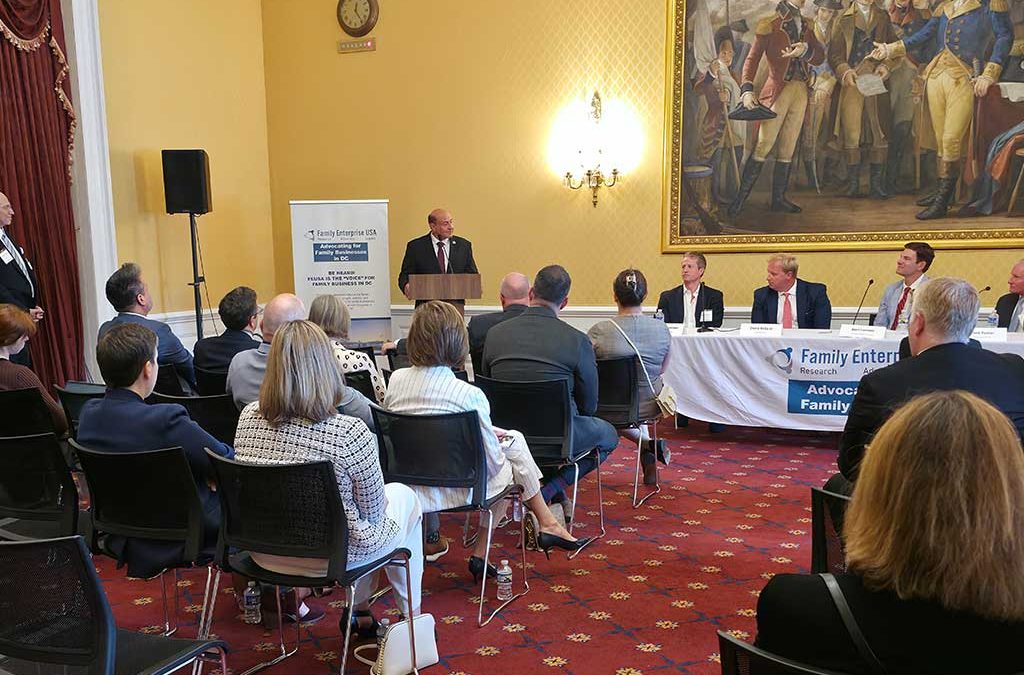
After Brownstein portion of the meeting, Caucus attendees were transported to the U.S. Capitol Building and room H117, the historic old House Members’ dining room. It was here the panel discussion among family-owned business leaders began, along with attendance and short talks by four House members. This portion of meeting, the official Caucus meeting, began at 11AM and ended at 12:30 PM.
The House Members that came to the Caucus meeting, and spoke to the group, were Rep. Rich McCormick (R-GA), Rep. John McGuire (R-VA), Rep. Lou Correa (D-CA), and Rep. Kevin Hern (R-OK). Rep. Correa is Co-Chair of the Congressional Family Business Caucus, along with Rep. Claudia Tenney (R-NY).
The panel discussion on new capital access strategies was led by Gugliada, and the groups’ new incoming CEO, Schultz.
The panelists included David Kelly, Director, Kelly Benefits, Frank Foster, Hixon Family Companies, Paige Kavooras, Executive Vice President, Global, A 1st Flagship Company, Nate Hamilton, Executive Chairman, FOX Office Exchange, and Bart Lamont, Partner, Hallador Investment Advisors.
Each panelist gave a short description of their businesses and how they were dealing with capital access issues and growth initiatives.
The panelists were asked such questions as “How do you and your family solve day-to-day capital or cash flow needs of the business?” and “Have you had to employ new strategies, due to the economic environment or the passage of HR1 or OBBB in the past 12 to 18 months?”
Additional questions asked by Gugliada and Schultz were: “What long term capital strategies have you deployed, and how have they worked?” and “Has access to adequate capital prevented you from planning for the next generation and passing the business on to them? If so, what can be done to fix that?”
Paige Kavooras, of Global, A 1st Flagship, responded on implementation of tax incentives for training and certification in skilled trades that allow for long-term investment in the marine industrial base workforce.
“Our focus is on workforce development and on meeting administration goals for shipbuilding and ship repair to support national defense,” she said. “We need to find ways to mitigate the financial strain of employer benefit costs, which currently hinder the ability of businesses to recruit and retain talent.”
On the subject of “wealth taxation,” Kavooras said it’s important to “advocate against taxes on unrealized gains, as such measures would negatively impact long-term business strategies and the sustainability of companies.”
David Kelly, of Kelly Benefits, discussed the complexities of new family members joining the company, and how the process for passing the business down to the next generation is described as often “ambiguous.”
“While I technically own a portion of the business,” he said, “the exact details of how trust and estate plans will execute are unclear because no one in the senior generation has passed away yet.”
Nate Hamilton, of FOX, discussed how good tax policies are crucial to survival and how he “sees time and again how awful tax policies really impact family businesses.”
Hixon’s Frank Foster talked about the damaging effects of the Estate Tax, or Death Tax.
Foster said the government “needs a tax policy that extends the death tax penalty over the long term, so as not to force family businesses to sell to private equity or to a public company.”
Bart Lamont, of Hallador Investment Advisors, spoke of working with Next Generation of family business leadership and dealing with financial investments.
“It’s difficult to ask a twenty-five-year-old to come up with a couple of million dollars for new equipment that will last only five or seven years,” he said. “Working through something like this on a daily basis as a family is not an easy issue.”
Capitol Hill Meetings
After this portion of the Caucus meeting concluded, attendees headed to lunch and were split into smaller groups with team leaders. After lunch, team leaders gathered their smaller groups and were assigned specific visits to designated House Member offices.
Each group met with House Members, or their staff, representing their district. In these in-person meetings attendees presented key issues affecting family-owned businesses, and specifically their businesses, and helpful growth policies, in the House Member’s district.
These “Hill Visit” meetings are integral part of each Caucus meeting and are managed by Team leaders, who develop specific message points delivered to House Members.
This portion of the day’s meeting ran from 2:30 PM to 5 PM. The House Member office visits concluded the second Congressional Family Business Caucus meeting and day of events.
We hope you’ve enjoyed this article. While you’re here, we have a small favor to ask…
As we prepare for what promises to be a pivotal year for America, we’re asking you to consider becoming a supporter.
The need for fact-based reporting of issues important to family offices and hardworking families and protecting a lifetime of savings has never been greater. Now more than ever, family offices and hardworking families are under fire. That’s why Family Enterprise USA Action is passionately working to increase the awareness of issues important to family offices and hardworking families, while continuing to strengthen our presence on Capitol Hill.
Family Enterprise USA Action engages with legislators on Capitol Hill on behalf of family offices, hardworking families, and family-owned businesses. It is focused exclusively on the critical tax and economic policies that impact them. Since 1995, FEUSA Action has been the leading advocacy group working daily in Washington, D.C., to reduce and eliminate estate tax, gift tax, and generation skipping transfer tax while blocking increased income and capital gains taxes, the creation of a wealth tax, and other hostile policies that punish hardworking taxpayers and success in the U.S. It is a bipartisan 501.c4 organization.